Merchant, Soldier, Sage by David Priestland
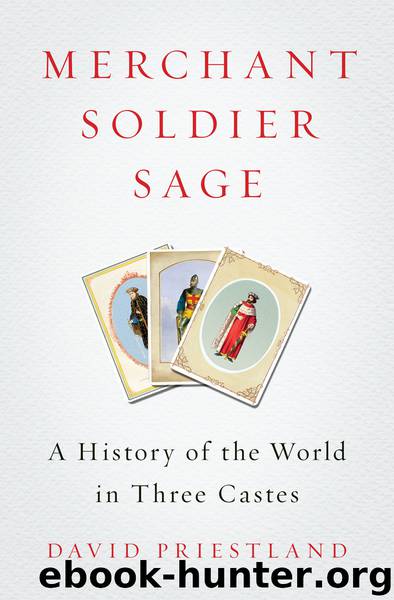
Author:David Priestland
Language: eng
Format: epub
Publisher: Penguin Group US
Published: 2013-02-19T16:00:00+00:00
The Merchant Militant
In 1952, a twenty-six-year-old financial consultant, Alan Greenspan, entered the Manhattan apartment of Ayn Rand—the fiercely pro-capitalist writer and intellectual—for the first time. The atmosphere was Russian in its intellectual intensity, and the scene a rather 1920s one, as might be expected from the salon of a woman who had spent her youth in early Soviet Leningrad. Her rooms were stark, with a dramatic view of the Manhattan skyline—befitting the author of The Fountainhead (1943), a bestselling novel heroizing a modern architect. And she herself adopted the rather masculine “modern” style popular among female students in the USSR in the 1920s; as Greenspan described her, “her face was dramatic, almost severe, with a wide mouth, broad brow, and great dark intelligent eyes—she kept her dark hair in a pageboy that emphasized them.”91 Greenspan visited her weekly for several years, and there is something slightly incongruous about this straitlaced “undertaker,” as Rand called him, becoming involved with a group notorious for its cultish atmosphere and sexual intrigues.
Greenspan was the most famous of Rand’s disciples, becoming the hugely influential head of the Federal Reserve in the 1990s and 2000s, but her ideas spread widely among the still small American pro-market right. In the 1960s, a young Republican activist and lawyer, David Bergland, remembered championing her views at party meetings in Orange County, California—one of the early heartlands of the conservative movement and a region that helped bring Ronald Reagan to power as governor of California in 1966.92
Why did this eccentric Russian émigré have such appeal among these right-wing free-marketeers? (Her books are still bestsellers, especially in the United States and India.)93 The answer lies, paradoxically, in the fit between the Russian society in which she grew up, rent by social and cultural conflict, and her new American home. For post-1960s America was also experiencing sharp political and ideological divisions—even if not quite as intense as those of revolutionary Russia. And it was her personal experience that enabled her to reclothe the old militant hard-merchant ideologies that had been influential before the Second World War in more modern garb, suitable for the second half of the twentieth century.
Ayn Rand was a very angry person, and her fury was understandable. She was born Alisa Rosenbaum to the family of a prosperous St. Petersburg pharmacist in the revolutionary year of 1905; the family’s shop was taken by the Bolsheviks in 1918, and they were forced to leave St. Petersburg (Petrograd) for south Russia. On their return, Rand became a student at Leningrad University—a place riven with class and political conflict—and she was expelled for a time as punishment for her “bourgeois” origins.94 Given this background, it is no surprise that Rand should have developed a deep hatred for socialism. But, of course, she had also imbibed the militant culture of that time. Her novels owe a particular debt to early Soviet culture: their melodramatic plots, in which ideologically polarized characters struggle for dominance, are strongly reminiscent of the socialist realist novels of the 1920s USSR.
Download
This site does not store any files on its server. We only index and link to content provided by other sites. Please contact the content providers to delete copyright contents if any and email us, we'll remove relevant links or contents immediately.
| Africa | Americas |
| Arctic & Antarctica | Asia |
| Australia & Oceania | Europe |
| Middle East | Russia |
| United States | World |
| Ancient Civilizations | Military |
| Historical Study & Educational Resources |
Cecilia; Or, Memoirs of an Heiress — Volume 1 by Fanny Burney(32561)
Cecilia; Or, Memoirs of an Heiress — Volume 2 by Fanny Burney(31958)
Cecilia; Or, Memoirs of an Heiress — Volume 3 by Fanny Burney(31944)
The Secret History by Donna Tartt(19097)
Sapiens: A Brief History of Humankind by Yuval Noah Harari(14392)
Leonardo da Vinci by Walter Isaacson(13339)
The Radium Girls by Kate Moore(12033)
Sapiens by Yuval Noah Harari(5374)
How Democracies Die by Steven Levitsky & Daniel Ziblatt(5221)
The Wind in My Hair by Masih Alinejad(5099)
Homo Deus: A Brief History of Tomorrow by Yuval Noah Harari(4921)
Endurance: Shackleton's Incredible Voyage by Alfred Lansing(4785)
Man's Search for Meaning by Viktor Frankl(4608)
The Silk Roads by Peter Frankopan(4537)
Millionaire: The Philanderer, Gambler, and Duelist Who Invented Modern Finance by Janet Gleeson(4481)
The Rape of Nanking by Iris Chang(4217)
Joan of Arc by Mary Gordon(4116)
The Motorcycle Diaries by Ernesto Che Guevara(4105)
Stalin by Stephen Kotkin(3970)
